Generate a reduction GIF in Node.js
@mettascript/grapher/node turns MeTTa source into an animated GIF from a normal Node.js program. It evaluates the reduction with MeTTaScript, builds the same SVG frames as the browser editor, rasterizes each frame with Sharp, and returns GIF bytes. It does not open a browser or require an HTML element.
The program below reduces (+ 10 (* 25 2)) to 60 and writes the animation to reduction.gif.
Create the program
Use Node 20.9 or newer. Start an ESM project and install the grapher with its optional rendering packages:
npm init -y
npm pkg set type=module
npm install @mettascript/grapher sharp gifenc
Create app.js:
import { writeFile } from "node:fs/promises";
import { renderReductionGif } from "@mettascript/grapher/node";

const gif = await renderReductionGif("(+ 10 (* 25 2))", {
  view: "blocks",
  width: 720,
});

await writeFile("reduction.gif", gif);
console.log(`Wrote reduction.gif (${gif.byteLength} bytes)`);
Run it:
node app.jsThe result is an image/gif file. The first frame contains the original expression, the middle frames show (* 25 2) becoming 50, and the final frame contains 60.
Include rules and facts
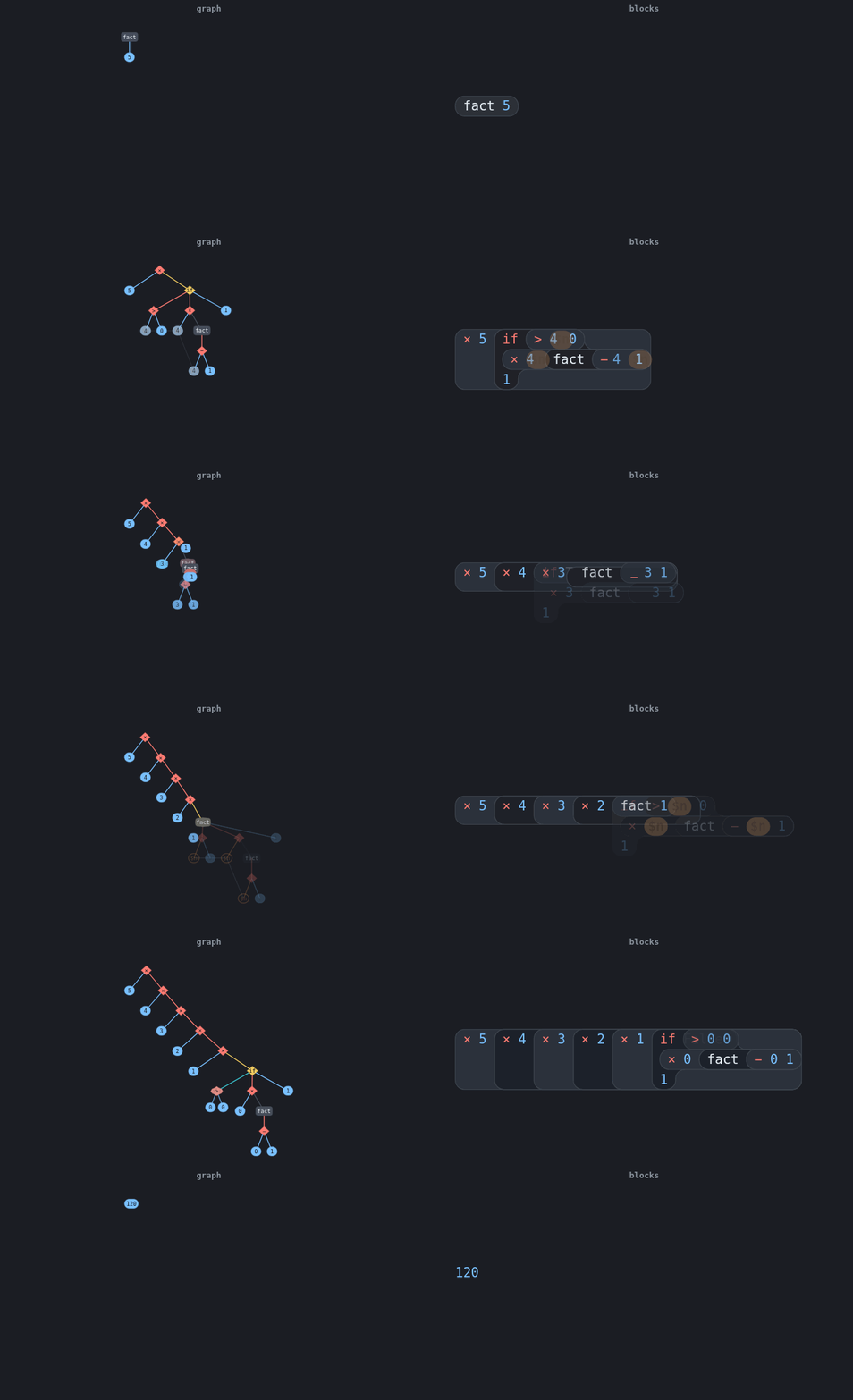
Pass a whole program when the query depends on definitions. The renderer loads all top-level atoms into one MeTTa space and traces the last atom whose head is not = or :. The normal ! query marker is accepted. Here the final !(fact 5) is the query:
const source = `
(= (fact $n)
   (if (> $n 0)
       (* $n (fact (- $n 1)))
       1))
!(fact 5)
`;

const gif = await renderReductionGif(source, {
  view: "blocks",
  width: 720,
});

await writeFile("factorial.gif", gif);
The same example is runnable in the repository: examples/grapher-gif.ts.
Choose the picture
The view option changes presentation, not evaluation. Every choice uses the same reduction trace.
await renderReductionGif(source, { view: "blocks" });
await renderReductionGif(source, { view: "graph" });
await renderReductionGif(source, { view: "side-by-side" });blocksdraws nested expressions as contained blocks.graphdraws terms as connected nodes.side-by-sideputs both pictures in one synchronized animation.
Reuse an existing MeTTa space
Pass a MeTTa instance when the query should use rules, facts, modules, or grounded operations already registered by your application:
import { MeTTa } from "@mettascript/hyperon";
import { renderReductionGif } from "@mettascript/grapher/node";

const metta = new MeTTa();
metta.run("(= (double $x) (* $x 2))");

const gif = await renderReductionGif("(double 21)", {
  metta,
  view: "graph",
});
The source passed to renderReductionGif is added to that space, matching the mounted editor's shared-space behavior.
Return a GIF from an HTTP handler
The renderer returns Uint8Array, so a server can return the bytes directly:
const gif = await renderReductionGif("(+ 10 (* 25 2))");

return new Response(gif, {
  headers: { "content-type": "image/gif" },
});
The function does not choose a filename or write to disk. Your application decides whether to save, upload, cache, or return the bytes.
Control animation size
width controls output width. framesPerStep, holdMs, stepMs, and maxFrames control timing and work. maxSteps bounds trace construction.
const gif = await renderReductionGif(source, {
  width: 960,
  framesPerStep: 8,
  holdMs: 300,
  stepMs: 35,
  maxFrames: 240,
  maxSteps: 500,
});
The Node entry rejects dimensions above 4096 pixels, more than 360 frames, more than 100 million total raster pixels, and outputs above 128 MiB. These checks reject oversized raster workloads and encoded results. Apply your own input-size and request timeout limits when rendering source from untrusted clients.
Generate SVG frames without native packages
The lower-level SVG builders do not require Sharp or gifenc. Use them when another renderer, image service, or command-line tool will consume the frames:
import { MeTTa } from "@mettascript/hyperon";
import { blockReductionSvgs, parseProgram, reduceTrace } from "@mettascript/grapher";

const query = parseProgram("(+ 10 (* 25 2))")[0];
const states = reduceTrace(query, new MeTTa());
const { frames, width, height } = blockReductionSvgs(states);

console.log(`${frames.length} SVG frames at ${width}x${height}`);
console.log(frames[0].svg);
Use graphReductionSvgs or sideBySideReductionSvgs for the other pictures.