02. Spaces and matching
Put three facts in a space, then ask for a shared relationship. A space keeps atoms and matches over them structurally.
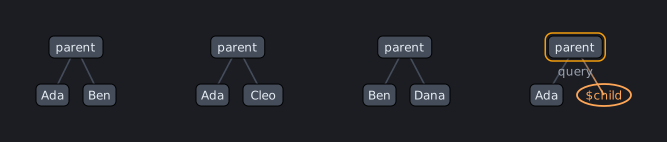
The first tutorial example stores a family chain and joins two patterns:
# Atoms are Python values: S mints symbols, V variables, application builds
# expressions, and none of it costs an engine call.
m.add(S.Parent(S.Tom, S.Bob), S.Parent(S.Bob, S.Ann), S.Parent(S.Ann, S.Zoe))
rows = m.match(S.Parent(V.gp, V.p), S.Parent(V.p, V.gc))
check("join count", len(rows), 2)
check("first grandparent", (rows[0].gp, rows[0].gc), (S.Tom, S.Ann))
Each Parent expression is stored without evaluation. In the first pattern, $gp and $p can bind. In the second, the same $p must keep the value already found. Shared variables therefore form a join.
For the visual's smaller question, the pattern (parent Ada $child) has the same head and arity as each fact. It accepts Ben and Cleo at the open position. The fact (parent Ben Dana) does not match, because Ben is not Ada.
m.match(...) returns Rows. Variable names become columns in first-appearance order, so $child is available as row.child. No match produces an empty Rows, not a null atom.
Use the spaces guide for named spaces, persistence, and Python-backed providers. Use Run and query for joins, guards, limits, assumptions, and prepared queries. Next, define a rewrite in 03. Equations and evaluation.