03. Equations and evaluation
An equation gives a matching expression a rewrite. The call (double 21) matches the left side (double $x), binds $x to 21, and rewrites through (* 21 2) to 42.
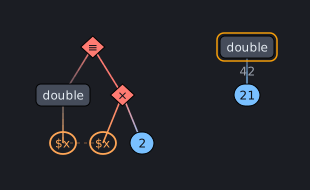
The repository's first example runs that exact rewrite:
# Source runs through the engine's own reader and compiler; one answer list
# per ! directive, grounded values arriving as Python values.
check("run", m.run("(= (double $x) (* $x 2))\n!(double 21)"), [[42]])
Read = as a rewrite definition. It is not Python assignment and it is not an equality test. The engine uses == for a value comparison inside a computation.
The ! directive starts evaluation. Source without ! adds an atom or equation to the current space. Source with ! evaluates its target and returns an answer group. One source string can contain several directives, so run returns an outer list of groups:
def test_run_groups_answers_per_directive(metta):
    r = metta.run("!(+ 1 2)\n!(superpose (a b))")
    assert r == [[3], [S.a, S.b]]
The second directive has two answers. MeTTa nondeterminism enumerates the answers licensed by the program. Two equations for (coin) can therefore answer both Heads and Tails; it does not choose one at random.
The Run and query guide covers evaluation bounds, streaming, transactions, profiling, and other runtime controls. Next, cross the language boundary in 04. The Python bridge.