06. Types and casting
Types are optional atoms. A declaration such as (: Ann Person) gives a value a type. A function declaration such as (: age (-> Person Number)) says that age accepts a Person and answers a Number.
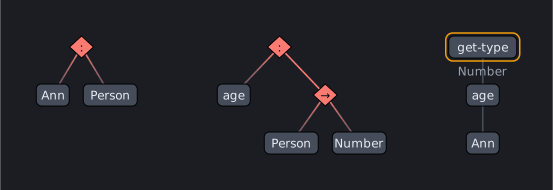
Python annotations can create function declarations at registration time:
def test_annotations_declare_types(metta):
    from metta.vocabularies import EffectClass

    name = unique("typed")

    @metta.op(name=name, effect=EffectClass.pureStructural)
    def typed_op(x: int) -> int:
        return x

    assert metta.run(f"!(get-type ({name} 1))") == [[S.Number]]
get-type asks what type the current space can derive. The arrow's final atom is the result type; preceding atoms are input types. A typed call that refuses an argument can disappear as an empty branch during nondeterministic evaluation.
A function's type has to be an arrow, and a source that gets this wrong is refused rather than accepted quietly. (: inc Number) beside (= (inc $x) (+ $x 1)) types the symbol inc, not a call to it. So every (inc ...) compiles with no check, and a wrong argument surfaces wherever it finally breaks, deep inside + rather than at inc itself. Writing (: inc (-> Number Number)) is what puts the check on the call. The engine refuses the first form when it loads the source:
(: inc Number) is not an arrow, so it types the symbol inc and not a call to
it: every (inc ...) compiles with no check at all, and a wrong argument
surfaces wherever it finally breaks instead of here. Write (: inc (-> ...)),
or (: inc %Undefined%) to say inc is deliberately untyped.
Three things pass. A name may carry several declarations, MeTTa's ad-hoc polymorphism, and one arrow among them is enough. %Undefined% says the function is deliberately untyped. And a declaration for a name nothing defines is data, not a defect, which is what lets (: nars-belief (--> Cat Animal)) mean inheritance rather than a mistyped arrow.
At a Python boundary, use m.cast when refusal must raise instead:
def test_declared_symbols_cast_by_their_declarations(m):
    m.run("(: Ann Person)")
    assert m.cast(S.Ann, "Person") is S.Ann
    with pytest.raises(CastError) as caught:
        m.cast(S.Ann, "Robot")
    assert "Person" in str(caught.value)
The successful cast returns the same symbol. The failed cast names the type the space knows. Declarations are space-relative, so another space can carry a different type environment.
See metta.casting for structural targets, protocol types, and Python type spellings. Next, inspect execution and support in 07. Seeing your program.