04. The Python bridge
Choose the bridge method from the value you already have. Use run for MeTTa source text, eval for an atom already built in Python, and query for bindings from stored facts.
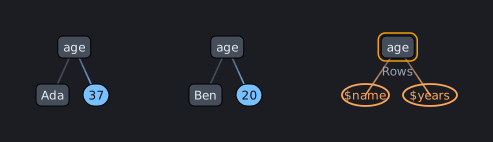
The core tests put the three value shapes side by side:
def test_eval(metta):
    assert metta.eval(S["car-atom"](Expression(1, 2, 3))) == [1]
    assert metta.eval(S.superpose(Expression(S.x, S.y))) == [S.x, S.y]
    assert metta.eval(Expression(S["+"], 20, 22)) == [42]


def test_source_strings_are_parsed_where_atoms_are_expected(m):
    m.add("(likes Ada Coffee)")
    assert m.match("(likes $who Coffee)")[0].who == S.Ada
eval returns the answers for one target atom. query returns bindings as named rows. run keeps one answer list per ! directive because a source string can contain several directives.
The boundary also goes from MeTTa into Python. Register a Python callable with @m.op, then evaluate its registered name like any other MeTTa function:
def test_det_op_composes_with_equations(metta):
    from metta.vocabularies import EffectClass

    name = unique("dbl")

    @metta.op(name=name, effect=EffectClass.pureStructural)
    def double(x: int) -> int:
        return 2 * x

    assert metta.run(f"!({name} 21)") == [[42]]
    quad = unique("quad")
    assert metta.run(f"(= ({quad} $x) ({name} ({name} $x)))\n!({quad} 5)") == [[20]]
Annotations tell the bridge which grounded Python values to pass and which type declaration to register. Effect metadata is separate and required; effect= is the canonical input and states the strongest observable behavior, from pureStructural through oracleIO. The Python callable runs only when evaluation reaches its term. Until then, the expression is data.
Use Python functions as MeTTa functions for annotations, generators, defaults, objects, and unregistration. Next, compile a Python body into equations in 05. Writing MeTTa in Python.