07. Seeing your program
Use a trace to see what ran, lint to inspect stored program structure, and a derivation to see why an answer holds.
Trace the reduction
m.trace runs source and records calls and answers. Depth follows recursive calls:
def test_trace_nests_calls_and_carries_answers(m):
    m.run("(= (tr-fact $n) (if (== $n 0) 1 (* $n (tr-fact (- $n 1)))))")
    events = m.trace("!(tr-fact 3)")
    calls = [e for e in events if e.kind == "call"]
    exits = [e for e in events if e.kind == "exit"]
    assert [str(c.term) for c in calls] == [
        "(tr-fact 3)", "(tr-fact 2)", "(tr-fact 1)", "(tr-fact 0)",
    ]
    assert [c.depth for c in calls] == [0, 1, 2, 3]
    assert str(exits[-1].term) == "(tr-fact 3)"
    assert exits[-1].answer == 6
    assert events[0].kind == "call"
Calls enter from depth zero to the base case. Exit events carry answers back out. Builtins stay inside the compiled step, so the trace centers your equations.
Lint the space
MeTTa can leave an unmatched expression unreduced. Lint catches common cases where that permissive behavior hides a mistake:
def test_declared_but_undefined(m):
    m.run("(: ghost-fn (-> Number Number))")
    findings = m.lint()
    assert _kinds(findings) == ["declared-but-undefined"]
    assert findings[0].subject == "ghost-fn"
Lint also checks arrow arity, call arity, unbound body variables, duplicate equations, and possible undefined references. The final category is heuristic because an unfamiliar expression head may be intentional data.
Read a derivation
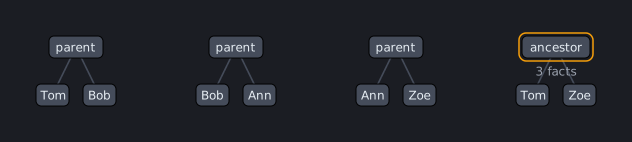
A derivation records the equations and stored facts that support one answer:
def test_multi_step_proof_names_equations_and_facts(metta):
    metta.run(
        "(par-d Tom Bob)\n(par-d Bob Ann)\n"
        "(= (anc-d $x $y) (match &self (par-d $x $y) $y))\n"
        "(= (anc-d $x $y) (let $m (match &self (par-d $x $m0) $m0) (anc-d $m $y)))"
    )
    proofs = metta.derivation(S["anc-d"](S.Tom, S.Ann))
    assert len(proofs) == 1
    proof = proofs[0]
    assert proof.answer == S.Ann
    assert {f.atom for f in proof.facts} == {
        S["par-d"](S.Tom, S.Bob),
        S["par-d"](S.Bob, S.Ann),
    }
    assert len(proof.rules) == 2
    text = str(proof)
    assert "by (= (anc-d $a $b)" in text
    assert "fact (par-d Tom Bob)" in text
See Run and query for trace, lint, derivations, profiling, and failure explanations. Next, learn how the same atoms become diagrams in 08. The graph view.