05. Writing MeTTa in Python
@m.define reads a Python function and adds its MeTTa equation to a space. Calling the decorated name evaluates through that space, S.name(...) builds a term explicitly, and .py keeps the ordinary Python function.
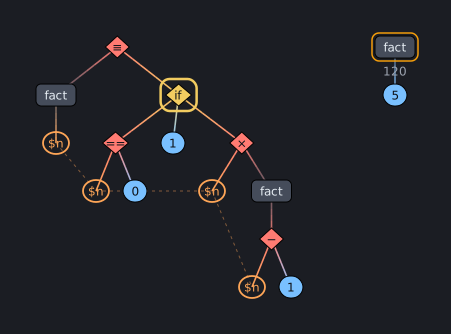
The runnable definitions example starts with factorial:
@m.define
def fact(n):                      # -> (= (fact $n)
    if fn.eq(n, 0):               # ->      (if (== $n 0)
        return 1                  # ->          1
    return fn.mul(                # ->          (* $n
        n, fact(fn.sub(n, 1))     # ->             (fact (- $n 1)))))
    )


check("equations run", m.run("!(fact 6)"), [[720]])
check("the Python twin agrees", fact.py(6), 720)
check("calling the name evaluates", fact(6), [720])
check("S builds the term", str(S.fact(6)), "(fact 6)")
The comment is the equation this body becomes, and you can read it back out of the space with m.self.atoms() rather than take it on trust. fn.eq, fn.mul, and fn.sub explicitly name engine relations, which is what a stored factorial equation needs.
An ordinary n == 0 or n * value instead invokes Python's live operator protocol at engine application time. That spelling is right for strings, lists, custom reflected methods, and any other Python value. It is not a relational arithmetic spelling: use fn.* when the equation must stay matchable or run backwards.
Calling fact(6) runs the compiled equation and returns all engine answers. S.fact(6) builds (fact 6) as data, and fact.py(6) runs the Python reference directly. Inside an @rules generator, calls to defined objects stage scope-locally so equation(lhs).to(fact(x)) still produces an ordinary equation atom.
Use direct MeTTa source when matching, free variables, or several clauses state the problem most clearly. Use @m.define when Python control flow is the clearest source but the behavior should run as equations, including try/except/finally, raise, dicts and sets, type aliases and global. Use @m.op when a Python library call or effect must stay in Python.
What the vocabulary lowers natively becomes equations; what it does not becomes a visible host island inside the equation, run per application, never at decoration time. The refusals that remain cite their ground in one of the two languages. An unresolvable name is Python's own NameError; a nonlocal targets a frame no stored equation outlives.
The Write MeTTa in Python guide covers repeated clauses, generators, comprehensions, matching, exceptions, and dicts as spaces. Next, add checked boundaries in 06. Types and casting.