06. Types and casting
Types are optional atoms. A declaration such as (: Ann Person) gives a value a type. A function declaration such as (: age (-> Person Number)) says that age accepts a Person and answers a Number.
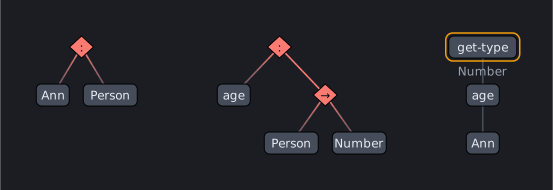
Python annotations can create function declarations at registration time:
def test_annotations_declare_types(metta):
    from metta.vocabularies import EffectClass

    name = unique("typed")

    @metta.op(name=name, effect=EffectClass.pureStructural)
    def typed_op(x: int) -> int:
        return x

    assert metta.run(f"!(get-type ({name} 1))") == [[S.Number]]
get-type asks what type the current space can derive. The arrow's final atom is the result type; preceding atoms are input types. A typed call that refuses an argument can disappear as an empty branch during nondeterministic evaluation.
A function's type has to be an arrow, and a source that gets this wrong is refused rather than accepted quietly. (: inc Number) beside (= (inc $x) (+ $x 1)) types the symbol inc, not a call to it. So every (inc ...) compiles with no check, and a wrong argument surfaces wherever it finally breaks, deep inside + rather than at inc itself. Writing (: inc (-> Number Number)) is what puts the check on the call. The engine refuses the first form when it loads the source:
(: inc Number) is not an arrow, so it types the symbol inc and not a call to
it: every (inc ...) compiles with no check at all, and a wrong argument
surfaces wherever it finally breaks instead of here. Write (: inc (-> ...)),
or (: inc %Undefined%) to say inc is deliberately untyped.
Three things pass. A name may carry several declarations, MeTTa's ad-hoc polymorphism, and one arrow among them is enough. %Undefined% says the function is deliberately untyped. And a declaration for a name nothing defines is data, not a defect, which is what lets (: nars-belief (--> Cat Animal)) mean inheritance rather than a mistyped arrow.
Name a reusable type expression with Alias:
(: Count (Alias Number))
(: Row (Alias (Count String)))
(: Identity (Alias (-> Row Row)))
(: row-id Identity)
(= (row-id $row) $row)
!(row-id (7 "seven")) ; (7 "seven")
!(get-type row-id)     ; (-> (Number String) (Number String))
An alias substitutes its right-hand side wherever a type is expected. Count accepts numbers and rejects strings. A positional Row checks each field. An alias of Atom also keeps arguments unevaluated and marks its result as final, just as writing Atom directly does. Aliases name complete type expressions; they do not introduce a new distinct type or take type arguments.
A local alias shadows an inherited declaration. Names inside an inherited alias keep their meaning in the space where that alias was declared. Declare an alias before the function annotation that uses it. Repeated variables in one alias expansion remain related; separate occurrences receive fresh variables.
Adding or removing an alias updates already compiled callers. Repeating the same definition is harmless. A different definition for the same alias in the same space raises a conflict; remove the old declaration before replacing it. Direct and indirect cycles raise an error with the expansion path. Failed transactions restore the previous declarations and compiled behavior. Compound changes still need the caller lock described in the thread guide; a transaction does not substitute for that lock.
get-type reports expanded types, while matching stored (: ...) atoms and exporting source retain the written alias. A type error retains that spelling and adds TypeExpansion when substitution changed the declaration.
You can put a cardinality and an effect class in a function arrow:
(: w (-[det,writesState]-> Number Number))
(= (w $x) $x)
The written type stays visible through get-type. Its effect publishes (effect w writesState) in &metta, so space.effect_plan(S.w(1)) reports writesState. A world covering only pureStructural refuses the call, even though this example's body is an identity. Removing the declaration removes its owned effect row. Effects join by name across the catalog, including declarations in other spaces; one declaration cannot weaken another or the effects found in a body. Removing an owned effect row directly is refused. Clearing &metta is also refused while declarations in other spaces still own effect rows there; remove those declarations first.
nondet joins its class with nondeterministicReadOnly. For example, (-[nondet,pureStructural]-> Number Number) has that joined class. Omitting the class, as in (-[det]-> Number Number), uses oracleIO.
An effect annotation reaches effect planning and world admission. It does not reach lib_memo: a written !(memoize w) is honoured over an annotated body, and an annotation added afterwards lands beside the live cache rather than withdrawing it. Whether a cache belongs on a function is the program's own decision.
Cardinality is an author assertion. By default it is trusted and does not prune answers. Enable auditing when you want execution to check it:
(: two (-[det]-> Number Number))
(= (two $x) $x)
(= (two $x) (+ $x 1))
!(pragma! verify-cardinality true)
!(two 1) ; raises: annotated call succeeded with a choicepoint
The check follows SWI's det/1 rule: det must succeed without a choicepoint; semidet may fail but must leave no choicepoint on success. nondet permits any number of answers. A choicepoint raises before another equation runs, including when the alternatives would produce equal answers or eventually fail. The body is executed once, so auditing does not replay its effects. An Empty result is not an answer. A call with an already constrained output checks only the upper bound, because that constraint can legitimately remove the result.
The mode is optional because this operational check is stricter than counting completed answers and adds work to annotated calls. It observes each executed call; it does not prove unexecuted branches. Use !(pragma! verify-cardinality none) to disable it, or scope it with with-pragma!. Plain -> calls retain their ordinary compiled goals in either mode.
A foreign space must declare transactional writes before storing an annotated arrow. An undeclared or best-effort provider is refused because a partial write could separate the type from its catalog effect. Plain arrows retain their existing storage behavior.
An annotation must name an ordinary function and use a concrete product. Product variables such as -[$effect]->, annotations nested in parameter or result types, and annotations on translated special forms or translator rules are refused at load with the unsupported claim named. Put a contract on an ordinary wrapper when a translated form needs one. An annotated function can still be passed to an ordinary higher-order parameter such as (-> (-> Number Number) Number Number).
At a Python boundary, use m.cast when refusal must raise instead:
def test_declared_symbols_cast_by_their_declarations(m):
    m.run("(: Ann Person)")
    assert m.cast(S.Ann, "Person") is S.Ann
    with pytest.raises(CastError) as caught:
        m.cast(S.Ann, "Robot")
    assert "Person" in str(caught.value)
Aliases work through the same Python cast door: after m.run("(: Count (Alias Number))"), m.cast(7, "Count") returns 7 and m.cast("seven", "Count") raises CastError. Casting requires a type witness: an unknown symbol cannot establish Count. Ordinary typed calls and MeTTa's type-cast retain their gradual acceptance of an unknown actual type.
The successful cast returns the same symbol. The failed cast names the type the space knows. Declarations are space-relative, so another space can carry a different type environment.
See metta.casting for structural targets, protocol types, and Python type spellings. Next, inspect execution and support in 07. Seeing your program.